
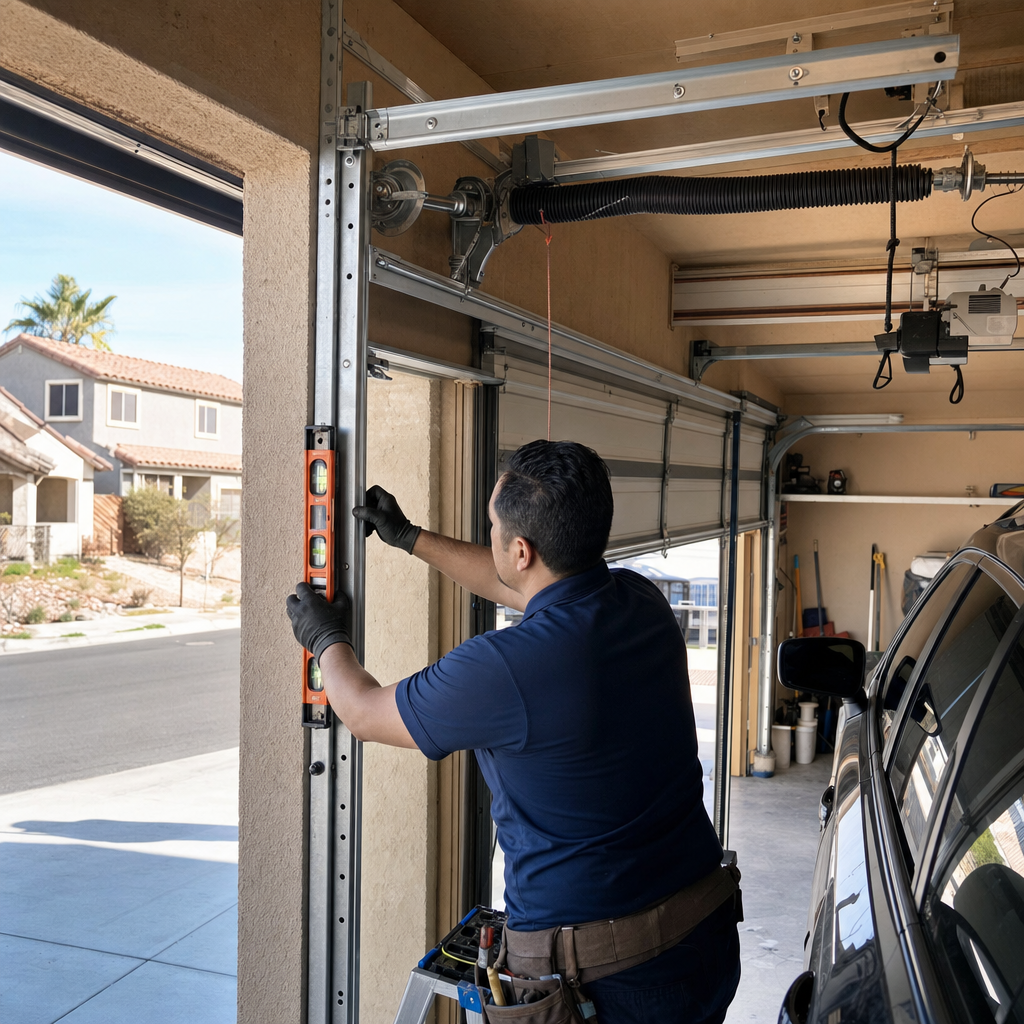
Last updated June 24, 2026
Garage Door Repair Maintenance Checklist for Las Vegas Homeowners
Most national garage door maintenance guides were written for climates where summers peak around 85°F and humidity keeps metal from drying out too fast. Las Vegas is not that climate. Out here, summer temperatures regularly push past 110°F, UV radiation degrades rubber seals in a single season, and the alkaline dust that blows in from the Mojave works into every hinge, roller, and spring channel you own. Follow a generic annual checklist in Las Vegas, and you’re not maintaining your garage door — you’re just documenting its decline. This guide gives you a maintenance schedule that’s actually calibrated to the Mojave desert, month by month, so your door doesn’t fail on a Saturday in August.
Quick Answer
A Las Vegas garage door maintenance checklist should include lubrication every 4–6 months (not the 12 months most national guides recommend), a pre-summer inspection in April, a post-monsoon check in October, and monthly visual inspections for UV-cracked weatherstripping and bottom seals. Desert heat accelerates lubricant evaporation, and alkaline dust turns dry metal into an abrasive — so the standard once-a-year schedule leaves your springs, cables, and rollers unprotected for half the year.
Table of Contents
- Why Las Vegas Is Different — And Why It Changes Everything
- Month-by-Month Maintenance Schedule for Las Vegas
- The Right Lubricants for Desert Heat (And the Ones to Avoid)
- Inspecting Weatherstripping and Bottom Seals for UV Damage
- How to Visually Inspect Cables and Springs Safely
- What to Log and Photograph at Every Inspection
- Common Mistakes to Avoid
- When to Call a Professional
- Frequently Asked Questions
- The Bottom Line
Why Las Vegas Is Different — And Why It Changes Everything
Standard maintenance intervals assume a temperate climate. Las Vegas delivers the opposite: peak summer heat that routinely hits 108–115°F, virtually zero humidity for eight months of the year, and then a monsoon season from mid-July through September that introduces sudden moisture, dust, and debris into a system that’s been baking in dry heat all summer.
Here’s what that actually does to your garage door system:
- Lubricants evaporate faster. A silicone or lithium grease applied in May can be functionally gone by July if it isn’t rated for high-heat applications. Dry metal-on-metal contact grinds through springs and rollers faster than almost any other wear mechanism.
- UV radiation destroys rubber. The Las Vegas sun doesn’t just fade your garage door paint — it oxidizes and cracks rubber weatherstripping and bottom seals in 12–18 months, sometimes less. A seal that looks intact from three feet away may be cracked through when you get down and look at it closely.
- Alkaline desert dust is abrasive. The fine particulate that blows in from the desert floor — common in neighborhoods like Summerlin, North Las Vegas, and the outer edges of Henderson — coats every moving part. When that dust mixes with even a thin film of lubricant, it forms a grinding paste that accelerates wear on rollers, hinges, and spring coils.
- Thermal expansion stresses hardware. Metal components expand significantly in 110°F heat and contract at night. Over time, that daily cycling loosens fasteners, shifts tracks slightly, and fatigues springs at a rate that doesn’t show up in national failure statistics.
None of this means your door is fragile — it means the maintenance schedule has to account for actual conditions on the ground in Las Vegas, not average conditions across 50 states.
Month-by-Month Maintenance Schedule for Las Vegas
The schedule below is built around three critical windows: pre-summer preparation (April–May), mid-summer monitoring (June–September), and post-summer restoration (October–November). Winter maintenance in Las Vegas is relatively light, but it still matters.
January – March: Winter Baseline Check
- Lubricate all moving parts — springs, hinges, rollers, and the opener’s chain or belt drive. Las Vegas winters are mild, but nightly lows in the 30s–40s can thicken lubricants and stiffen spring coils.
- Test the door’s balance: disconnect the opener, lift the door manually to about waist height, and release it. A balanced door stays in place. One that drops or rises quickly has spring tension that needs adjustment.
- Inspect all bolts and brackets for looseness. Thermal cycling from fall has had two months to work fasteners loose.
- Wipe down the weatherstripping and assess for any cracking from last summer’s UV exposure.
- Test the auto-reverse safety function on your opener — place a 2×4 flat on the ground under the door and close it. The door should reverse on contact.
April – May: Pre-Summer Prep (Most Important Window)
- Full lubrication of all moving parts with a high-heat-rated lubricant (details in the next section). This is the single most important maintenance task of the year in Las Vegas.
- Inspect the bottom seal in full daylight. Get down on one knee and look along the seal’s contact edge. UV cracking shows as fine lateral cracks across the rubber — replace the seal before monsoon season introduces the moisture it’s supposed to block.
- Check the door’s weatherstripping on all four sides. Press your finger into the rubber — it should flex without cracking. If it feels brittle, it’s already degraded.
- Inspect the springs visually for rust spots, gaps between coils, or any coil that looks visibly different from the others. Do not touch or attempt to adjust them — just observe and photograph.
- Tighten all visible hardware: roller brackets, hinge fasteners, track mounting bolts. The heat cycle that’s coming will expand the metal further; loose hardware now becomes a problem in July.
- Clean the door’s exterior and apply a UV-protectant product to painted or wood surfaces. Steel doors with faded paint are absorbing more heat — which accelerates interior hardware temps.
June – September: Monsoon Season Monitoring
- After any significant monsoon storm, visually inspect the bottom seal and door threshold for debris accumulation or seal displacement.
- Check the tracks for dirt and debris that blew in during the storm — a monsoon can push significant dust into the track channel in a single event.
- Re-lubricate at 6-week intervals during peak summer if the door is used frequently. High daily cycling combined with heat evaporates lubricant faster than the rest of the year.
- Listen for new sounds: grinding, squeaking, or a thudding noise from the opener are all early warnings in summer heat. Address them before they escalate.
October – November: Post-Summer Restoration
- Full post-season inspection: this is when you assess what three months of extreme heat did to your system.
- Check for any UV cracking that developed mid-summer on seals and weatherstripping.
- Re-lubricate all moving parts. Anything that was applied in April has likely been reduced significantly by summer heat and use.
- Test door balance again — spring tension can shift after a full summer heat cycle.
- Inspect the opener’s safety sensors for alignment and clean any dust off the sensor lenses. Monsoon dust can coat the sensors and cause intermittent failures.
December: Light Year-End Check
- Visual inspection of all hardware — no full lubrication needed unless the October service was skipped.
- Test the opener’s battery backup if your LiftMaster, Chamberlain, or Genie unit has one.
- Confirm weatherstripping seals properly on all four sides before the coldest nights of the year.
The Right Lubricants for Desert Heat (And the Ones to Avoid)
The lubricant question matters more in Las Vegas than anywhere else in the Southwest. Get it wrong and you either have metal running dry in a desert summer, or a gummy residue that traps alkaline dust and turns into an abrasive compound.
What Works in Las Vegas Heat
- White lithium grease spray: The right choice for springs, hinges, and rollers. It adheres well at high temperatures, resists evaporation better than light oils, and doesn’t attract dust the way heavy petroleum greases do. Apply sparingly — excess grease drips and collects debris.
- Silicone-based lubricant spray: Best for weatherstripping and the door’s rubber bottom seal. It conditions the rubber without degrading it, and it won’t stain your concrete floor. Do not use it on metal spring coils — it doesn’t provide enough film strength under load.
- Specialty garage door lubricant (aerosol): Products specifically labeled for garage door springs are formulated for the temperature range and load conditions involved. Several major brands sell this directly, and it’s what we use in our service visits.
What to Avoid
- WD-40 (original formula): It’s a water displacer, not a true lubricant. In Las Vegas heat, it evaporates within weeks, leaves a residue that attracts dust, and provides no lasting protection on spring coils. We see doors that were “maintained with WD-40” regularly — they always need more work than doors that weren’t lubricated at all.
- Heavy petroleum grease (like bearing grease): Too viscous for door hardware. It collects alkaline desert dust and eventually creates the grinding paste mentioned earlier. It’s also nearly impossible to clean off when you need to inspect hardware condition.
- Cooking oils or improvised lubricants: They go rancid and gummy in heat, leave organic residues that attract debris, and don’t provide meaningful protection on metal under tension.
Lubrication points to hit every service: torsion spring coils (the full length), extension spring coils if applicable, all hinges, all roller stems (not the nylon wheel itself — just the metal stem), the top of each track, and the opener’s chain or belt drive rail lightly.
Inspecting Weatherstripping and Bottom Seals for UV Damage
This is the section most Las Vegas homeowners skip — and it’s the one that causes the most avoidable repair costs. A failed bottom seal lets monsoon water into your garage, allows desert dust to accumulate on your vehicles and belongings, and creates a pathway for pests. In our experience, UV degradation of rubber seals is one of the top five reasons Las Vegas homeowners call us for what they initially describe as “a door problem” — when really it’s a seal problem that went unnoticed.
Bottom Seal Inspection Steps
- Close the garage door completely and go inside with a flashlight on a bright day.
- Look along the bottom edge of the door where the seal meets the concrete. Light coming through along any section indicates the seal is no longer making full contact — either from wear, UV hardening, or cracking.
- From outside, get on one knee and visually examine the rubber. UV-cracked rubber shows as hairline cracks running perpendicular to the seal’s length. Run your fingernail lightly along the surface — a degraded seal will show white stress lines in the rubber.
- Press the seal between your thumb and forefinger. Healthy rubber compresses and springs back. UV-degraded rubber feels stiff, crumbles at the edges, or cracks under pressure.
- Check the seal track channel (the aluminum retainer at the door’s bottom panel). If the seal has been sliding or shifting, the retainer itself may be bent or loose — a condition that prevents even a new seal from seating properly.
Side and Top Weatherstripping Inspection
- Run your hand along the interior edge of all four sides of the door with the door closed. Drafts indicate gaps.
- Look for UV bleaching (color change) on the rubber — a visible sign that the material has started to oxidize. Bleached sections are typically harder than the surrounding rubber.
- Check that the weatherstripping is still fully seated in its retaining channel. Las Vegas homes in areas like the southwest valley and Summerlin regularly see weatherstripping that has partially pulled out of its track due to thermal expansion and contraction cycles.
Replacing weatherstripping and bottom seals is one of the lower-cost maintenance tasks — but only if you catch it before a monsoon season, not after.
How to Visually Inspect Cables and Springs Safely
Critical safety note first: Torsion springs are under extreme tension — enough to cause serious injury if a coil lets go. The inspection steps below are visual only. You are looking, not touching. If you see anything concerning, the correct response is to stop using the door and call a technician. Never attempt to adjust, repair, or remove spring hardware yourself.
Torsion Spring Visual Inspection (above the door)
- With the door closed and the opener disconnected from power, stand a few feet back and look at the torsion bar above the door.
- Examine each spring along its full length. You’re looking for: a visible gap in the coils (the spring has partially broken), rust spots or pitting along individual coils, any coil that looks wider-spaced than its neighbors, or visible wear at the spring’s end cones where it meets the bracket.
- Photograph what you see with your phone. Even if everything looks fine today, a timestamped photo library lets a technician spot progressive wear at your next service visit.
- Look at the end cones and winding cones at each end of the spring. Cracks at the cone-to-spring junction are an early failure signal.
Cable Visual Inspection
- With the door closed, look at the cables that run along the sides of the door from the bottom cable drum down to the bottom bracket at the door’s base.
- Look for: fraying (individual wires separating from the cable strand), kinking (a sharp bend in the cable that indicates it’s been under abnormal stress), rust or corrosion on the cable strands, or cable that’s sitting loose and slack rather than taut.
- Check the cable drum at the top of each side — the cable should be wound evenly in the drum grooves. Cable that has jumped a groove will cause the door to open unevenly and puts asymmetric stress on the entire system.
- Check the bottom cable bracket where the cable attaches to the door’s bottom corner. Bent brackets or cracked welds here are a common Las Vegas failure point due to thermal stress.
In the Las Vegas heat, we see cable fraying and end-cone cracking more frequently on doors that are used multiple times per day — a common pattern in households where the garage is the primary entry point. If your inspection turns up anything that doesn’t look right, stop operating the door until it’s been assessed.
What to Log and Photograph at Every Inspection
A maintenance log is the difference between catching a problem at $150 and catching it after it’s become a $450 emergency. It takes about five minutes per visit and has genuinely helped homeowners avoid failures that would have been entirely predictable in hindsight.
What to Record
- Date and current outside temperature. Las Vegas-specific — a check done in October at 85°F and one done in July at 112°F are producing different baseline readings for the same hardware.
- Lubrication: what product was used, what was lubricated, and how much. If a spring starts making noise three months from now, knowing when it was last lubricated and with what eliminates half the diagnostic variables.
- Any sounds the door is making. Describe them specifically: grinding vs. squeaking vs. thumping vs. clicking. These sound different because they come from different components.
- Door balance test result. Note whether the door stayed in position at mid-height, drifted down, or rose. If you’re testing quarterly, a pattern of increasing drift tells you spring tension is degrading before it becomes a failure.
- Seal condition rating. A simple 1–5 scale at each inspection. When the rating drops below 3, it’s time to plan a replacement.
- Any hardware you noticed had changed. A bolt that was hand-tight last time but loose this time, a roller that looks more worn, a cable that appears slightly rustier.
What to Photograph
- The full-length spring(s) at the same angle every time — changes in coil spacing or surface rust become visible across a series of photos even when they’re subtle at any single visit.
- The bottom seal from the same position inside and outside.
- Any hardware that concerned you — bracket welds, cable drum windings, roller stems.
- The opener’s wall button and keypad — note any cracking in the housing from heat exposure.
If you work with Pioneer Garage Door Solutions Las Vegas, bringing your log and photos to a service visit allows us to make better assessments in less time — and helps you avoid paying for diagnostics that your own documentation already answers.
Common Mistakes to Avoid
- Following a 12-month lubrication schedule in Las Vegas. Every major national guide says to lubricate annually — but that interval assumes a temperate climate. At Las Vegas summer temperatures, lubricant can evaporate or degrade in 4–6 months. Waiting a full year leaves your springs running partially dry through the hottest part of the year.
- Using WD-40 as a primary lubricant. It’s a penetrating oil, not a load-bearing lubricant. It feels like it’s working when you spray it, but it evaporates quickly and leaves behind a residue that traps alkaline desert dust — creating an abrasive compound on the very parts you were trying to protect.
- Ignoring the bottom seal until water gets in. By the time monsoon water is entering under your door, the seal has been failing for months. UV cracking starts as a surface condition that closes up when the rubber is warm — making it invisible on a summer afternoon — and opens fully when it gets wet. Inspect by touch and light-test, not just by looking at it in daylight.
- Testing spring tension by yanking the door manually. The balance test described in this guide — lifting gently to mid-height and releasing — gives you accurate information. Pulling the door hard or bouncing it introduces forces the springs weren’t designed for and can accelerate wear on already-fatigued hardware.
- Lubricating the tracks. This is one of the most common DIY mistakes we see, including in homes across the Henderson and Summerlin areas. Tracks are meant to be clean and dry — the rollers roll along them. Lubricating the track surface causes rollers to slip rather than roll, which creates noise, uneven door travel, and additional stress on the opener’s drive system.
- Skipping the post-monsoon inspection in October. Homeowners tend to do spring prep and then consider the year handled. But monsoon season introduces moisture, debris, and rapid temperature changes that do real work on your hardware. A brief October check catches what three months of desert summer left behind.
- Assuming a quiet door is a healthy door. Spring tension loss, gradual cable fraying, and track misalignment can all develop silently until the failure itself is loud. Regular visual inspection — not just listening for noises — is the only way to catch wear before it becomes a breakdown.
When to Call a Professional
Call a technician — and stop operating the door — if you observe any of the following during your inspection:
- A visible gap in a torsion spring coil, or any section of the spring that looks different from the rest
- Frayed, kinked, or slack cables on either side of the door
- A door that won’t stay in position at mid-height, or opens/closes unevenly (one side faster than the other)
- Grinding or scraping sounds that persist after lubrication
- An opener that strains, reverses unexpectedly, or fails the auto-reverse safety test
- Bent or cracked hardware at the bottom cable brackets or roller mounting plates
- A door that moved suddenly or slammed during operation
These aren’t “monitor it” situations — they’re “stop using it” situations. A door with a failing spring or compromised cable can drop or come off track without warning.
For Garage Door Repair in Winchester and across the Las Vegas metro area, Pioneer Garage Door Solutions offers free estimates and emergency service for situations that can’t wait. Call (775) 258-9354 to reach the owner directly — not a dispatcher.
Frequently Asked Questions
How often should I lubricate my garage door in Las Vegas?
In Las Vegas, lubricate your garage door springs, hinges, and rollers every 4–6 months — not the 12 months most national guides recommend. The combination of extreme summer heat and alkaline desert dust accelerates lubricant breakdown significantly faster than in temperate climates. For doors that get heavy daily use (4+ cycles per day), the 4-month interval is more appropriate. Call (775) 258-9354 for a free estimate if you’d like a professional lubrication and inspection done right.
What is the best lubricant for garage doors in Las Vegas heat?
White lithium grease spray is the best all-purpose choice for springs, hinges, and roller stems in Las Vegas temperatures — it resists evaporation and doesn’t attract dust the way heavy greases do. Use silicone-based spray on rubber weatherstripping and bottom seals to condition the rubber without degrading it. Avoid WD-40 as a lubricant — it evaporates quickly in desert heat and leaves a residue that traps abrasive dust.
How do I know if my garage door springs are about to fail?
Visually inspect the full length of your torsion springs with the door closed. Warning signs include: a visible gap in the coils (indicating a partial or complete break), rust spots or surface pitting along the coil, any individual coil that looks more widely spaced than adjacent coils, and cracking at the end cones where the spring meets its mounting bracket. If you see any of these, stop using the door and call a technician. Never attempt to adjust or touch spring hardware yourself — the tension involved is genuinely dangerous.
Why does my garage door bottom seal keep cracking in Las Vegas?
UV radiation from the Las Vegas sun breaks down the rubber compounds in bottom seals faster than in most U.S. markets — typically causing visible cracking within 12–18 months of installation if the seal isn’t UV-rated or isn’t maintained with silicone conditioner. The seal’s failure pattern is sneaky: UV cracks may close up when the rubber is warm and dry (making the seal look fine in summer daylight), then open and allow water infiltration during a monsoon event. Inspect by touch and by the light-gap method described in this guide, not just by looking at it during the day.
Can I install or replace a garage door opener myself in Las Vegas?
Opener replacement is within reach for handy homeowners in straightforward situations — a direct swap of an existing opener for a compatible unit on an otherwise functional door. However, the correct installation of units from brands like LiftMaster, Chamberlain, or Genie involves correct spring tension, travel limit calibration, safety sensor alignment, and force adjustment settings that directly affect whether the auto-reverse function works properly. An improperly installed opener can pass your initial test and still fail the safety standard under real-world load. For a new Garage Door Opener in Winchester or anywhere in the Las Vegas area, having it installed by someone who works on these systems daily eliminates that risk. Call (775) 258-9354 for a free estimate.
How much does garage door maintenance cost in Las Vegas?
A professional maintenance visit in Las Vegas typically covers lubrication of all moving parts, hardware inspection and tightening, balance test, safety sensor check, and a visual assessment of springs and cables. Pricing varies based on door size, hardware condition, and whether any parts need immediate attention — which is why an in-person assessment is the only way to give you an accurate number. Pioneer Garage Door Solutions Las Vegas provides free estimates with no obligation, so you’ll know the full picture before any work begins. Call (775) 258-9354 to schedule.
The Bottom Line
A garage door in Las Vegas works harder than a door almost anywhere else in the country — and it needs a maintenance schedule that reflects that. Lubricate every 4–6 months, not annually. Inspect your bottom seal and weatherstripping before monsoon season, not after. Do a thorough visual check of springs and cables quarterly, photograph what you see, and log the results. The homeowners who avoid emergency calls are the ones who treat April and October as their two most important service windows. Everything else in this guide supports those two moments.
If you find something during your inspection that doesn’t look right, or if you’d rather have a trained set of eyes go through the full system, we’re available for service across the Las Vegas metro. We stock parts and have hands-on experience with LiftMaster, Chamberlain, Genie, Clopay, Amarr, Wayne Dalton, Craftsman, and Raynor systems — so whatever brand is over your car, we’re not seeing it for the first time. For new door options, you can also explore Garage Door Installation in Winchester to understand what a full door upgrade looks like when the time comes.
Call (775) 258-9354 for a free estimate. You’ll reach the owner directly — the same person who’ll show up, assess the system, and do the work.
Written by the team at Pioneer Garage Door Solutions Las Vegas, serving Las Vegas since 2021.